


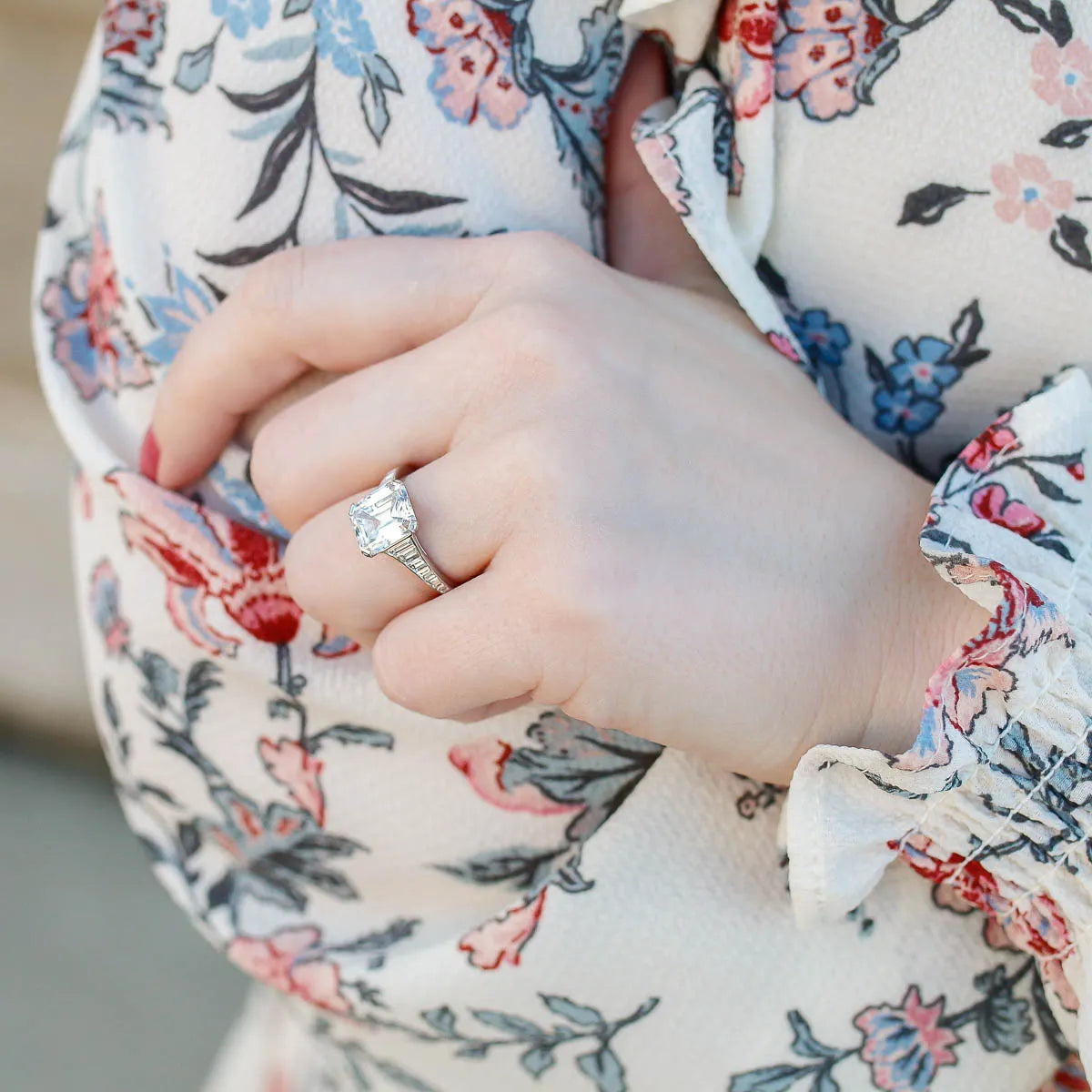
When diamond shopping, you’ll most certainly hear a jeweler mention the “4-Cs.” It’s how the jewelry industry rates diamonds around the world. Cut, Color, Clarity, and Carat weight. Each of the four qualities comes with its own measurement and grading system. The higher the grade, the better the quality of the diamond is (and, unsurprisingly, more expensive).
Of the four, we believe Cut is the most important. Because “beauty is in the eye of the beholder,” a higher price doesn’t necessarily mean a better-looking diamond. Let’s examine why…
Color
Nature has created more colors than the mind can imagine. Like no grain of sand is the same, diamonds also show up in an infinite number of colors.
Most range from a hint of yellow to a dull brown. Occasionally, a truly colorless diamond emerges. This is the rarest of all and will likely cause the diamond to cost the most. The Gemological Institute of America (GIA) uses an agreed-upon color scale to determine the color rating for each diamond.
Clarity
As diamonds are formed, natural “flaws” occur.
These rare gems have been sitting under thousands of tons of earth for millions of years. Dirt, water, air…even volcanic eruptions…cause marks within the diamond. Some are completely invisible to the naked eye, while others can be easily seen with a magnifying glass. The fewer flaws a diamond has, the higher the clarity. A true “flawless” diamond is the rarest of them all.
Carat
The carat weight is quite simply how much this diamond weighs. 1 carat equals 1/5 of a gram. Of the 4-Cs, this measurement is the most precise. While there could be some disagreement on color or clarity, carat weight is simply a matter of putting the diamond on a scale. But a diamond can only be weighed after it has been cut into the form you’ll eventually buy. Which brings us to why we feel the cut is the most important of the 4-Cs.

Cut
Out of each of the 4-Cs, Cut is the only aspect we have any real control over. The other three are influenced by nature. Cut is also the thing we can see both close-up and far away. How a diamond is cut will determine how much light it catches and reflects. The cut is also the shape the diamond takes (round, princess, emerald, oval, etc). To make a diamond sparkle across the room, it must be cut at very precise angles. A master jeweler can cut a diamond to remove flaws in clarity or cloudy parts that affect the color. Each cut will take a little bit of weight off, thus lowering the carat. Balancing what to take out and what to leave in can be the thing that impacts everything else.
The 4-Cs is the standard used around the world, and each “C” has its own importance in the equation of determining the quality of a diamond. Once it leaves the store, it’s very unlikely anyone will get out a microscope, scale, or color chart. But everyone will stop what they’re doing to look at the delicate stone that seems to flash light all by itself.
Diamonds can be confusing, and all the little details can get overwhelming. When you’re ready to learn more, stop into our Palo Alto or San Francisco, CA locations and we will help break it all down for you!
