


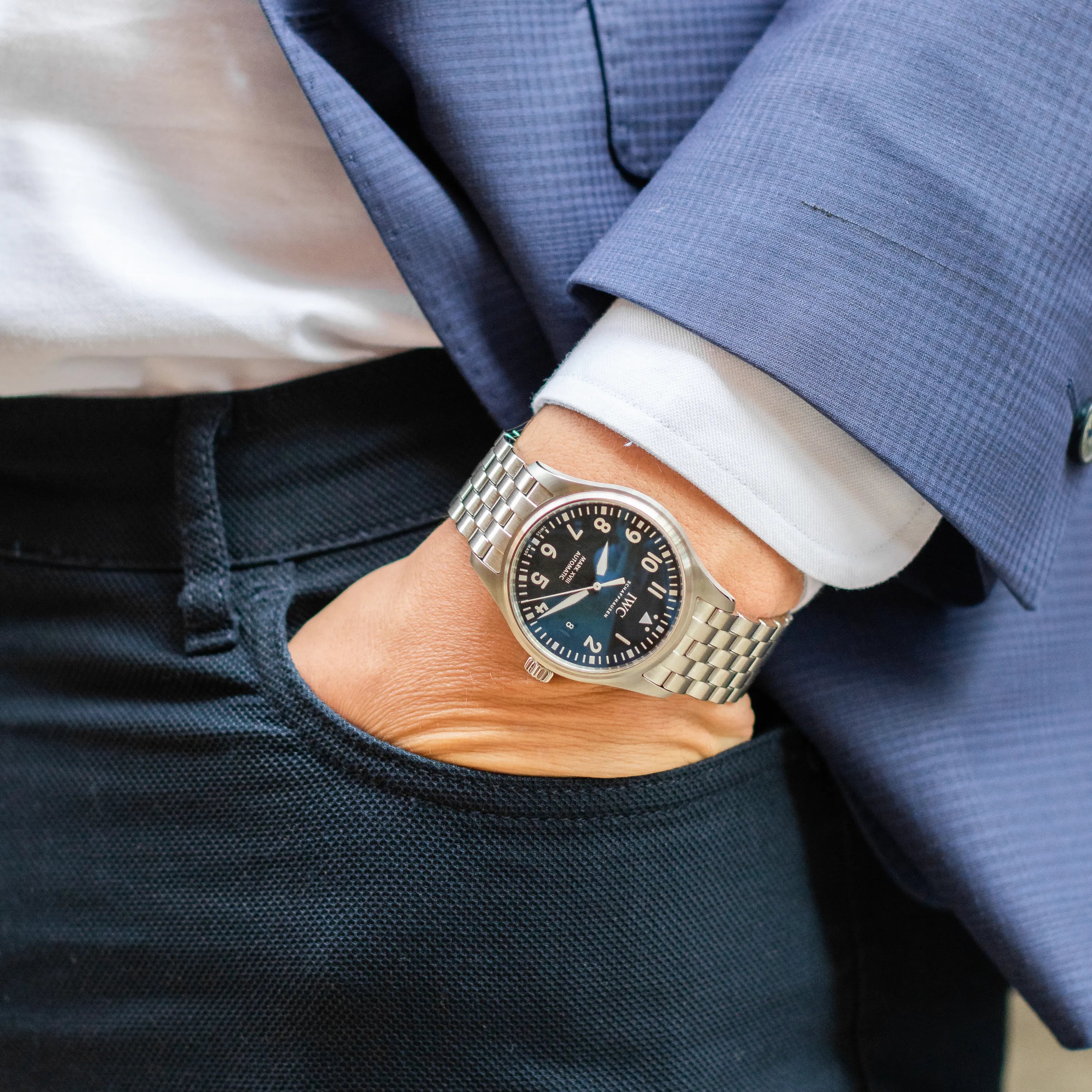
If your first guess was the face and hands, it's time to look a little deeper into your watch. Of course, the look and function are important, but the most essential part of your timepiece is...the mainspring.
This under-appreciated little marvel is the only way you could have a timepiece on your wrist. Without it, you're carrying around a full-size clock. But with all the advancements in watch technology, it's amazing to think how vital the mainspring really is.
Early clocks were powered by weights like you might see in an older Grandfather clock. The idea is entirely dependent on gravity and precise mechanisms. Weights are at the end of a rope, which is tied around a pulley. As the weight is slowly pulled downwards, it causes a rotational torque which then moves the gear train. Until they figured out how to accomplish the same thing on a smaller scale using the spiral steel springs, having a portable timepiece just wasn't an option.
 When were they first used in watchmaking?
There's some debate about where and when they started using springs in timepieces. Some believe it's possible that springs were used by locksmiths to construct secure and reliable locks. It's believed that craftsmen in Northern Italy were the first use this new technology.
How does a spring help tell time?
When you wind your watch, the spring is coiled around a steel rod (called an arbor), and the other end of the spring is attached to the barrel. The arbor stays stationary so when the watch is wound, the barrel rotates and gear teeth engage the pinions of the center wheel in the movement. But that's just one part that makes it work. The mainspring is for power and the balance spring is for the regulation of balance motion.
How it's made:
Before any of this could be put into practice, craftsmen had to have an understanding of metallurgy. The first skill needed was knowing how to turn iron into steel. But it gets even more intricate: The watchmaker needed knowledge of metal and its specific properties. A spring needs to be malleable and elastic, but also strong. The next trick was to shape the steel into a thin blade 12 to 22 inches long and coil it into a barrel. But we're not done yet: This coiled steel is full of energy, but is has to release it in such a way that the balance vibrates for 30 hours. Skilled workers in the 18th century spent days upon days figuring out the right steel to use, drawing the steel into wire, and filing a taper from one end to the other.

Mainsprings still work the way they did centuries ago, but much of the work of creating the spring is now automated. This gives the watchmaker absolute precision and consistency. A better understanding of metal alloys and the higher precision of parts have made it so watches can have longer and longer power reserves than ever thought possible.
The technology changes would be absolutely mind-blowing for a watchmaker visiting from the 1700s, but the mighty mainspring would be a familiar sight. In that area, very little has changed.
The next time you get a compliment on your timepiece, remind that person that the real beauty is hidden deep inside.
